Modeling and Simulation

Strategic Efficiency: How Model-Informed Drug Development (MIDD) Can Waive Clinical Studies and Accelerate Timelines

Introduction: The High Cost of “Checking the Box” For emerging biotech companies, cash runway is oxygen. The cost of developing a new drug has skyrocketed to over $2 billion, with the clinical phase consuming the vast majority of that budget. Every month spent in clinical development burns capital, shortens patent life, and delays the path […]
Strategic Efficiency: How Model-Informed Drug Development (MIDD) Can Waive Clinical Studies and Accelerate Timelines Read More »

Quantitative Systems Pharmacology (QSP) in Clinical Development: When to Use It, What It Delivers, and How to Make It Regulatory-Ready

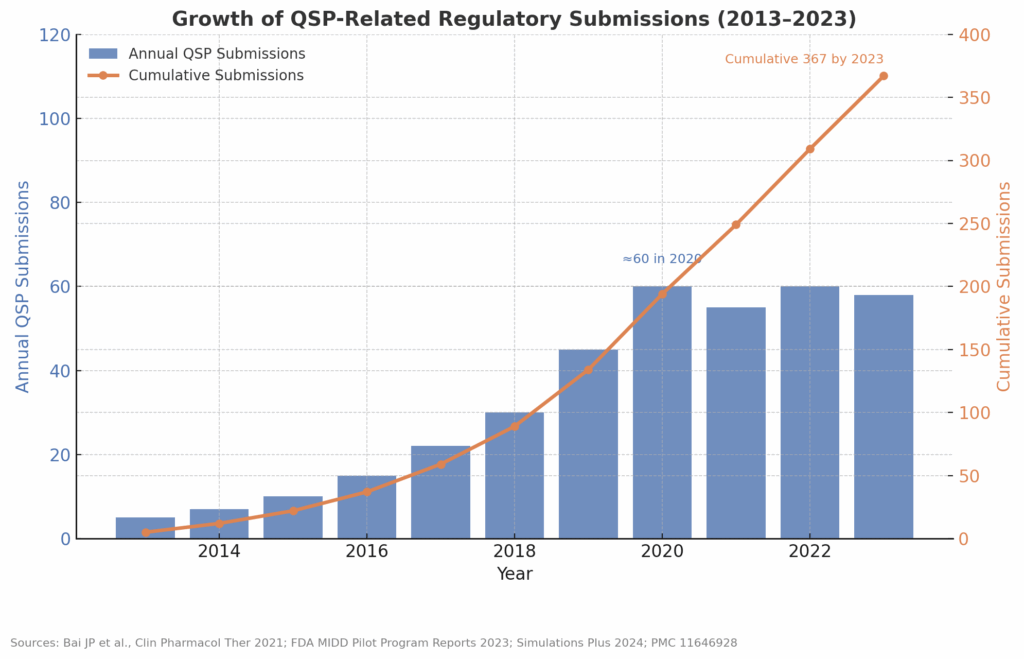
Audience: biotech C-suites, program leaders, clinical pharmacology & modeling teams. Why QSP matters now Sponsors increasingly face decisions where empirical models alone (PopPK, exposure–response) are not enough—novel mechanisms, combinations, complex biology, and heterogeneous populations. Quantitative Systems Pharmacology (QSP) integrates disease/biology knowledge with pharmacology to generate testable, decision-grade predictions across the translational and clinical continuum (e.g.,

Quantitative Systems Pharmacology (QSP) in Clinical Development: When to Use It, What It Delivers, and How to Make It Regulatory-Ready Read More »

PBPK and QSP: Two Powerful Tools for Drug Development — When and Why to Use Each

In today’s complex drug development landscape, PBPK and QSP modeling are key tools that help bridge data, de-risk decisions, and support regulatory interactions. PBPK Modeling Physiologically Based Pharmacokinetic (PBPK) models describe drug disposition in the body based on organ-specific physiology and biochemistry. They are commonly used for: PBPK is especially useful in early development and

PBPK and QSP: Two Powerful Tools for Drug Development — When and Why to Use Each Read More »